Unlock the full potential of Wavestore v6.52 -view our launch presentation today and explore the latest innovations in video management.
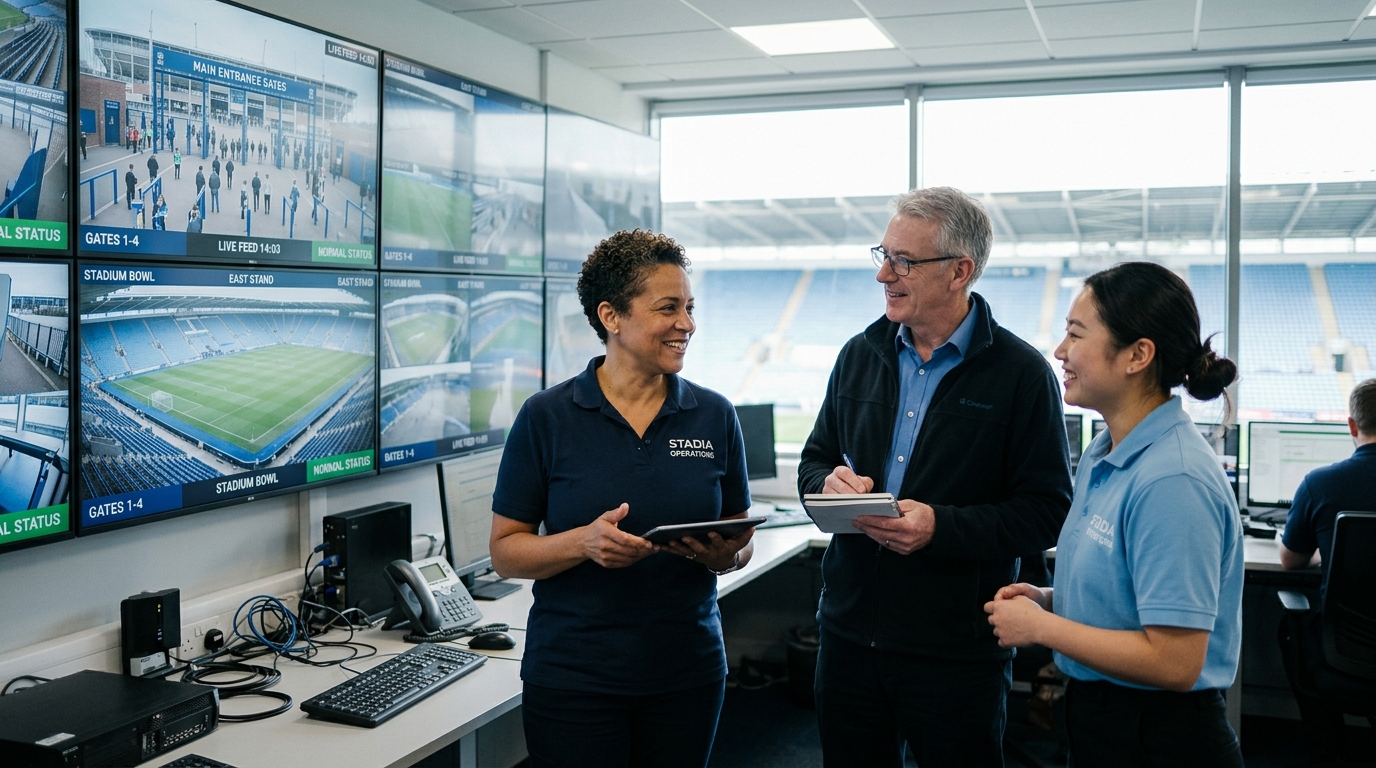
A stadium control room (also called a sports venue control room or command and control centre) is the room from which a venue's safety and security operation is directed on matchday. Safety officers, police commanders, stewards' leads and trained operators work there side by side. It controls CCTV, public address, radio, fire alarms, turnstile counts and emergency overrides, and it is where decisions to hold, redirect or evacuate a crowd are made and logged.
A stadium control room is the command and control centre where safety officers, police and stewards jointly direct a matchday. A standard CCTV room watches and records; a stadium control room also runs public address, radio, fire alarms and emergency overrides, and can trigger an evacuation.
The Sports Grounds Safety Authority (SGSA) lists the life-safety systems a control room runs: CCTV monitoring, direct landlines or intercoms to key locations, safety radio networks, giant-screen overrides and an uninterruptible power supply, typically around 15 minutes on battery.
BS 7958:2015 is the British Standard code of practice for the management and operation of CCTV where the public has a right of access. It covers the camera side only, so stadium operators also work from the Green Guide, the SGSA's Guide to Safety at Sports Grounds, and Supplementary Guidance 03.
Design the room around the operator: seated, adjustable consoles, primary screens roughly 15–20° below eye level, controlled glare and, where possible, a direct view of the pitch. ISO 11064 sets the ergonomic principles, and BS 7958:2015 covers how the CCTV side is managed.
Group positions by function: CCTV, radio, public address, fire and the event log. Place the safety officer and police commander where they can see both the video wall and the pitch. SGSA covers the location and layout of control points in Annex C of Supplementary Guidance 03, content that derives from a 2005 Football Licensing Authority publication. The sources we reviewed give no fixed number of operator positions per capacity band, so size the room from your own risk assessment.
The video wall gives everyone in the room the same picture; operators work on their own console screens. SGSA also advises that giant screens for spectators should be operated outside the control room, with emergency override available from inside it.
The UK Health and Safety Executive (HSE) points to ISO 11064 for control room design, alongside BS EN ISO 6385:2004 and EEMUA Publication 201. Console manufacturers translate this into working figures: worksurface lighting of 200–500 lux for screens, a unified glare rating of 19 or below and a monitor-to-background contrast of no more than 10:1.
The safety officer holds executive authority for spectator safety, the police commander leads public order and takes over if a major incident is declared, and the chief steward directs the stewards. All three sit together in the control room under the Green Guide and SG03. The US uses a unified command model instead.
In the UK the Green Guide and SG03 set the safety management structure with the safety officer in charge. SGSA's safeguarding guidance also expects a Safeguarding Plan to be embedded in the control room's operations manual.
The US has no direct counterpart to the Green Guide. It relies on voluntary guidance from the Cybersecurity and Infrastructure Security Agency (CISA), including its Venue Guide for Security Enhancements, and on unified command under the National Incident Management System in an Event Operations Center, where venue management, private security, police and fire share decision-making.
Operators work in three phases: pre-match checks of public address, fire panels and turnstile counts; in-match scanning of stands, concourses and pitch boundaries; and post-match exit and dispersal control. Alarms are verified, escalated to the safety officer, and handed to police if a major incident is declared.
Pre-match (ingress): Operators run diagnostics on public address, fire panels and red phones, and watch turnstile entry counts build. In-match: They scan seating bowls, concourses and pitch boundaries for overcrowding, blocked aisles, pyrotechnics and disorder. Post-match (egress): They coordinate exit gate release, watch dispersal towards transport, archive the logs and secure the facility.
An alarm starts with a steward report or a camera detection. The operator verifies it on camera and reports to the safety officer, who decides whether to hold, redirect, evacuate, invacuate or lock down. If a major incident is declared, command passes to police.
Fatigue is the weakest-evidenced area in the sources we reviewed. Console guidance links poor monitor angles, glare and 12-hour shifts to strain and falling alertness, but the SGSA and HSE pages set no break schedules. Write your own rota and task-rotation rules into the operations manual.
A modern control room needs four layers: a video management system as the operator interface, crowd density analytics to flag crush risk early, access control tied to video, and, only where lawfully justified, live facial recognition. The strongest set-ups are built on open standards, so all four appear in one auditable interface.
During an incident, operators need one interface, not several systems to switch between. Wavestore VMS is built on open standards and integrates video, access control, audio and intelligent automation, and its Health Monitor and Data Reporter modules add automated fault alerts and compliance reporting.
G. Keith Still's summary of Fruin's levels of service puts movement at around 3 people per square metre as restricted, about 4 as the point where serious crush risk starts, and 5 or more as conditions associated with fatal crushes. The 2022 Itaewon crush was modelled at an average of about 7.57 people per square metre, with peaks near 9.95. Wavestore says WaveView's occupancy counting, density thresholds, directional flow and queue monitoring are built into the core platform, that one Wavestore AI Server handles up to 115 deep-learning channels, and that deep-learning classification reduces false alarms by up to 90% against motion-only detection. For a fuller comparison, see our guide to crowd control video analytics.
Access control should close entry points rapidly, log every event and let operators verify an alarm on video, with separate audit-logged control for restricted areas.
In the UK, live facial recognition in public places is covered by the Information Commissioner's Opinion on its use, together with UK GDPR and the Data Protection Act 2018. In outline, a controller needs a lawful basis, a completed Data Protection Impact Assessment and a justification for processing biometric data, which UK GDPR treats as special category data.
Martyn's Law, the Terrorism Act 2025, sets its strictest duties for venues expecting 800 or more people, which covers most stadiums. The control room becomes the place where monitoring, response and audit records are kept. The SIA is the regulator, and enforcement is not expected before spring 2027.
For the full requirements, read our Martyn's Law venue security systems guide and work through the Martyn's Law compliance checklist for stadiums.
Since early 2017, Wavestore VMS has recorded video at Montevideo's three largest stadiums, built on high-resolution cameras and Herta facial recognition so operators can identify problem individuals and refuse them entry. The project won Best Private Security Project in Latin America at the 2018 ALAS Awards, and was later upgraded to Wavestore v6.38.
By the end of 2016, vandalism and violence at Uruguayan football matches had become a significant concern. The Uruguayan Football Association (AUF) and the two most prominent clubs, Club Nacional de Football and Club Atlético Peñarol, wanted to identify problem individuals before they entered the stadiums, and to use video to identify and penalise people who caused disturbances inside them.
In early 2017, Wavestore VMS went live at Estadio Centenario, Estadio Campeón del Siglo and Estadio Gran Parque Central for real-time video recording. High-resolution cameras were paired with Herta's facial recognition so that operators could spot problem individuals and prevent their entry. Local partner HO Tecnología (DDBA Ltda) is the liaison between the AUF and Wavestore, and carried out the upgrade.
As security demands grew, the AUF moved to Wavestore v6.38. The case study lists four changes for operators:
Wavestore's case study says the system has markedly reduced disturbances and improved event management, that troublemakers are now identified faster and more accurately, and that post-match investigations benefit from better search. These are vendor-reported outcomes with no figures attached. Read the full Uruguay stadium facial recognition case study.
It is the command and control centre for matchday safety, where police, stewards and safety officers share one view of CCTV, public address, radio and alarms.
The safety officer, police commander and chief steward, plus operators for CCTV, radio, public address and fire, and a loggist who records events.
The Green Guide and Supplementary Guidance 03 (2021) cover control room location, staffing, communications and the safety officer's authority.
SGSA's control room guidance says images and recordings should be kept with the event logs for a minimum of 60 days, while data protection law requires you to keep footage no longer than necessary for its purpose. Set a period, justify it in your Data Protection Impact Assessment and document it.
It applies to the venue. Enhanced-duty venues, those expecting 800 or more people, need a documented, auditable security operation, and the control room is where that evidence sits. See the Martyn's Law compliance checklist for stadiums.
Looking for the wider picture? See Wavestore's stadium security systems and its video management software.

Solutions for a world we can't yet see. Discover v6.52 features helping people and businesses.