Unlock the full potential of Wavestore v6.52 -view our launch presentation today and explore the latest innovations in video management.
Walk into most commercial buildings today and you'll find multiple sophisticated systems operating in complete isolation from one another. The video surveillance system records footage independently. The access control system manages who can enter which doors based on its own database. The intruder alarm system monitors sensors and triggers alerts through its dedicated panel. The fire safety system operates on its own network with separate monitoring. Each system performs its designated function competently, but they exist in parallel universes—unable to communicate, correlate information, or coordinate responses.
This siloed approach creates significant operational inefficiencies and missed opportunities. When an incident occurs, security personnel must manually check multiple systems to piece together what happened. Automated responses are impossible because systems can't trigger actions in other systems. Valuable contextual information that could inform better decisions remains locked within individual platforms. The promise of "smart buildings" remains unfulfilled because the systems that should work together simply don't speak the same language.
The evolution of Video Management Systems (VMS) as integration platforms is fundamentally changing this landscape. Modern VMS platforms are designed to act as the central nervous system of a unified security and operations ecosystem—connecting cameras with access control, alarms, environmental sensors, building management systems, and countless other Internet of Things (IoT) devices. This integration enables something far more powerful than the sum of individual systems: automated, intelligent workflows where one device detecting an event can instantly trigger coordinated actions across multiple systems. This article explores how IoT integration transforms the VMS from a video recording tool into the command and control centre for truly smart, responsive environments that enhance security, improve safety, and deliver operational intelligence.
IoT integration in the context of video management means enabling your VMS to communicate bidirectionally with other sensors, devices, and systems throughout your facility or organisation. Rather than operating as isolated islands of technology, integrated systems can share data, trigger actions, and coordinate responses based on events detected by any connected device.
The concept is elegantly simple: when one device in the ecosystem detects a condition or event, it can automatically trigger actions in other connected devices—without human intervention. An access control reader detecting an unauthorised credential attempt can automatically cue the nearest camera to that door and alert security personnel with the live feed already displayed. A temperature sensor detecting abnormal heat can trigger cameras in that zone to begin recording at higher resolution whilst simultaneously alerting facilities management. A retail point-of-sale system completing a high-value transaction can automatically bookmark the corresponding video footage for easy loss prevention review.
This bidirectional communication creates a responsive, intelligent environment where systems work in concert rather than in isolation. The VMS becomes more than a repository for video—it becomes the integration layer that provides visual context and verification for events detected across the entire building infrastructure.
Common IoT devices that integrate with modern VMS platforms include:
Each of these devices generates valuable data and can both contribute to and benefit from integration with the VMS. The video context that cameras provide enhances the value of sensor data, whilst sensor data helps cameras focus on what matters most.
The true value of IoT integration becomes clear when examining specific scenarios where coordinated, automated responses deliver outcomes impossible with siloed systems. These workflows demonstrate how integration enhances security, improves safety, and generates operational intelligence:
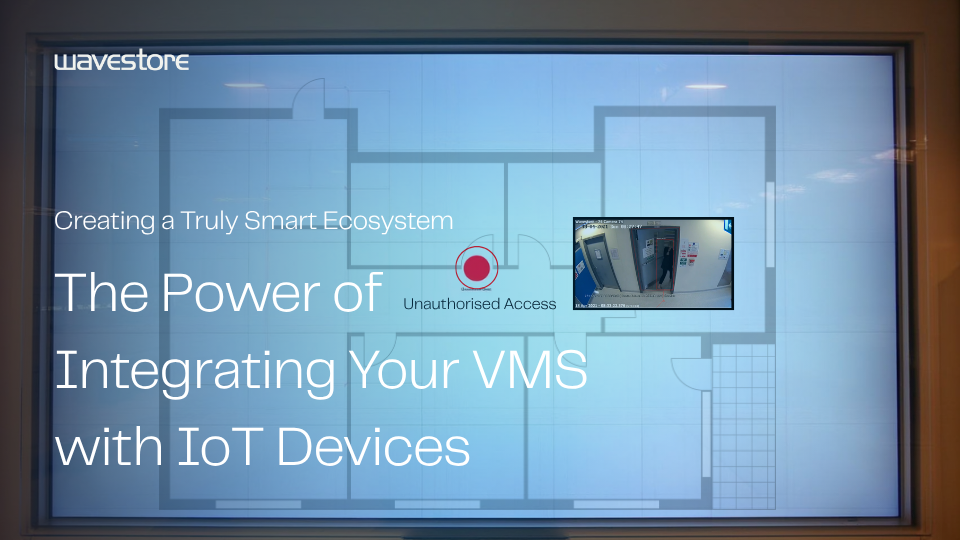
Scenario: At 2:30 AM, an individual approaches the rear entrance of your facility and presents an expired access credential. Without integration, the access control system would simply deny entry and perhaps log the attempt—but no one might notice until reviewing logs the next day, if at all.
With IoT Integration: The moment the access control system denies the credential, an automated workflow triggers instantly:
The entire sequence happens in seconds—providing security staff with full situational awareness and the ability to respond whilst the event is still unfolding. The video evidence is captured at optimal quality and already bookmarked for later review. What would have been a log entry discovered hours later becomes an actively managed security response.
This same integration principle applies to multiple security scenarios: tailgating detection where one person follows another through an access-controlled door, loitering alerts from video analytics triggering increased attention from cameras and security staff, or perimeter breach detection coordinating cameras, alarms, and automated verbal warnings.
Scenario: A fire alarm is triggered on the third floor of an office building. In a traditional environment, the fire alarm panel alerts the monitoring centre, security personnel might check cameras manually if they think to do so, and building occupants begin evacuating based on audible alarms.
With IoT Integration: The fire safety system's detection triggers a comprehensive, coordinated emergency response:
Throughout the emergency, the VMS provides continuous visual monitoring, allowing incident commanders to see evacuation progress, identify anyone who might need assistance, verify that evacuation routes are clear, and coordinate response resources effectively. All camera footage is automatically preserved as a permanent record for post-incident analysis.
This integrated approach doesn't just improve response speed—it potentially saves lives by ensuring coordinated actions happen instantly and correctly every time, without relying on manual procedures that might be forgotten or delayed in high-stress situations.
Scenario: In a retail environment, a till registers a £500 refund transaction—a relatively common occurrence that could easily be legitimate but is also a frequent method of internal theft. Without integration, loss prevention staff would need to manually search for the timestamp in video archives, find the correct camera, and review footage—a process that might take 15-20 minutes per investigation.
With IoT Integration: The POS system's transaction data flows directly into the VMS, creating automated operational intelligence:
The same integration principle extends to multiple retail scenarios:
Beyond retail, similar operational intelligence applies across industries:
This operational integration transforms video from a reactive forensic tool into a proactive business intelligence platform that provides objective data for process improvement, staff training, and compliance verification.
Not all video management systems are created equal when it comes to integration capabilities. Understanding the technical attributes that enable robust, reliable integration helps organisations evaluate platforms and make informed decisions:
The foundation of effective integration is a VMS designed from the ground up to work with third-party products rather than trying to lock users into a proprietary ecosystem. Open platform VMS solutions embrace interoperability, recognising that organisations have diverse technology environments with various manufacturers' equipment already deployed.
Look for VMS platforms that:
An open platform philosophy benefits organisations by:
The alternative—closed, proprietary systems—might seem simpler initially but often creates long-term constraints that limit flexibility and increase costs as your needs evolve.
The API is the technical mechanism that enables different systems to communicate—essentially the "language" that allows your VMS to speak with access control systems, building management platforms, and other IoT devices. A powerful, well-documented API is essential for creating the sophisticated integrations that deliver real business value.
Key API capabilities to evaluate:
For organisations with in-house development capability or specialised requirements, a robust API enables custom integrations tailored to unique workflows. Even for organisations using only pre-built integrations, the API quality affects reliability and performance.
Whilst a powerful API enables countless integration possibilities, certified pre-built integrations provide immediate, proven interoperability with leading manufacturers' products. These integrations have been developed, tested, and validated by either the VMS provider or the third-party manufacturer, ensuring reliable operation.
Benefits of certified integrations include:
When evaluating VMS platforms, examine their technology partner ecosystem:
Leading VMS platforms typically offer dozens or even hundreds of certified integrations, demonstrating their commitment to interoperability and providing organisations confidence that their specific technology requirements can be met.
The evolution of video management systems from standalone recording platforms to comprehensive integration hubs represents one of the most significant advances in how organisations approach security, safety, and operational management. A modern VMS is no longer merely about capturing and storing video—it's about serving as the command and control centre for an entire ecosystem of interconnected IoT devices, creating intelligent, automated environments that respond instantly to events and provide unprecedented operational intelligence.
By breaking down the silos that have traditionally separated security systems, access control, building management, and business operations, integrated VMS platforms enable workflows that are smarter, faster, and more effective than any individual system operating alone. Security responses happen in seconds rather than minutes. Safety systems coordinate automatically during emergencies. Operational data gains visual context that transforms it from numbers on a screen into actionable business intelligence.
The business case for integration extends beyond operational efficiency to include reduced labour costs (through automation of manual processes), improved risk management (through faster, more coordinated responses), enhanced compliance (through automatic documentation and audit trails), and better decision-making (through correlated data from multiple sources).
However, realising these benefits requires choosing a VMS platform designed for integration from the ground up. Look for systems with an open platform philosophy that embraces interoperability, robust APIs that enable sophisticated bidirectional communication, and comprehensive ecosystems of certified integrations with the specific technologies relevant to your operations. The platform you choose today should be flexible enough to integrate with technologies you haven't even considered yet—because the pace of innovation in IoT and smart building technology shows no signs of slowing.
For organisations managing complex facilities, multiple sites, or sophisticated operations, the question is no longer whether to integrate but how quickly you can transition from siloed systems to a unified, intelligent ecosystem. The technology exists today to create buildings and facilities that think, respond, and optimise themselves. By placing an integration-capable VMS at the centre of that ecosystem, you create the foundation for a truly smart environment that enhances security, improves safety, and delivers operational excellence that siloed systems simply cannot match.
The future belongs to integrated platforms. The only question is whether your organisation will lead that future or be left behind maintaining disconnected systems from the past.

Solutions for a world we can't yet see. Discover v6.52 features helping people and businesses.