Unlock the full potential of Wavestore v6.52 -view our launch presentation today and explore the latest innovations in video management.
"Built-in AI analytics" gets printed on almost every VMS product page in 2026, and it means at least three different things depending on who's writing it. Sometimes it means the detection model runs natively inside the platform's own codebase. Sometimes it means the platform ships an app marketplace where a partner's plugin does the actual detection. Sometimes it means the analytics live on the camera's own chip before any VMS is involved at all. Buyers comparing "AI analytics" across vendors are frequently comparing three different architectures under one label.
That distinction matters more than any single feature list, because it determines who you call when a detection model needs retraining, whether an analytics licence renews separately from your VMS licence, and whether your camera hardware locks you into one vendor's detection engine. This article sets out what "built-in" should actually mean, how the platforms most often named for this question (Milestone XProtect, Genetec Security Center, Avigilon Unity/Alta, Hanwha Vision and Wavestore) build their AI analytics, and what to check before you take a vendor's own comparison at face value.
A detection model owned and maintained by the VMS vendor itself, running inside the core platform, is a genuinely different commitment from a marketplace plugin built and maintained by a third party that happens to install inside the same interface. Both get marketed as "AI analytics." Only one of them means the vendor controls the model's roadmap, its retraining, and its long-term support.
The clearest recent example of this distinction changing under a vendor is Milestone. Historically, XProtect's advanced video analytics leaned on Milestone's App Platform and third-party partners plugging in through it. In 2025, Milestone acquired BriefCam (alongside Arcules), and its own subsequent press release describes a "38% improvement in real-time throughput" from the updated BriefCam engine, plain-language forensic search, and processing that runs on-premise with no cloud dependencies. That analytics engine is now Milestone's own, not a partner's, which matters if you're evaluating XProtect against a claim that it has no built-in models: that claim stopped being accurate the moment the acquisition closed.
Genetec sits at the other end of the same spectrum, and says so in its own documentation. Genetec's Resource Center lists KiwiVision Security Video Analytics as a feature note under its partner ecosystem, not as a Genetec-built engine, consistent with how Genetec documents its perimeter intrusion detection (also handled through named partner integrations rather than an in-house analytic). That's a legitimate way to reach broad hardware and use-case coverage quickly, but it means the actual detection model, its accuracy, and its update cadence depend on which partner is behind a given deployment, not on Genetec itself.
Avigilon's own AI video analytics page names specific capabilities directly: crowd detection, facial recognition, licence plate recognition, object detection, perimeter protection, and PPE detection, alongside its established Appearance Search feature for finding a specific person or vehicle without manual review. What Avigilon's own page doesn't specify is whether these models are self-learning in the sense of improving from a given site's own footage over time, despite that framing appearing in some third-party coverage. Worth confirming directly with Avigilon on that point for a specific deployment, since the vendor's own material doesn't make the claim explicitly.
Hanwha Vision takes a hardware-first approach: its Wisenet AI cameras and newer Wisenet 9 chipset generation push detection processing onto the camera itself, ahead of and independent of whichever VMS the footage ultimately lands in. That's a genuinely different architecture again, edge-first rather than platform-first, and it's worth understanding if you're comparing Hanwha's on-camera analytics against a server-side engine like BriefCam or Wavestore's AI Server: they're solving the same problem at a different point in the pipeline, and the honest comparison is architectural, not a single "better" verdict.
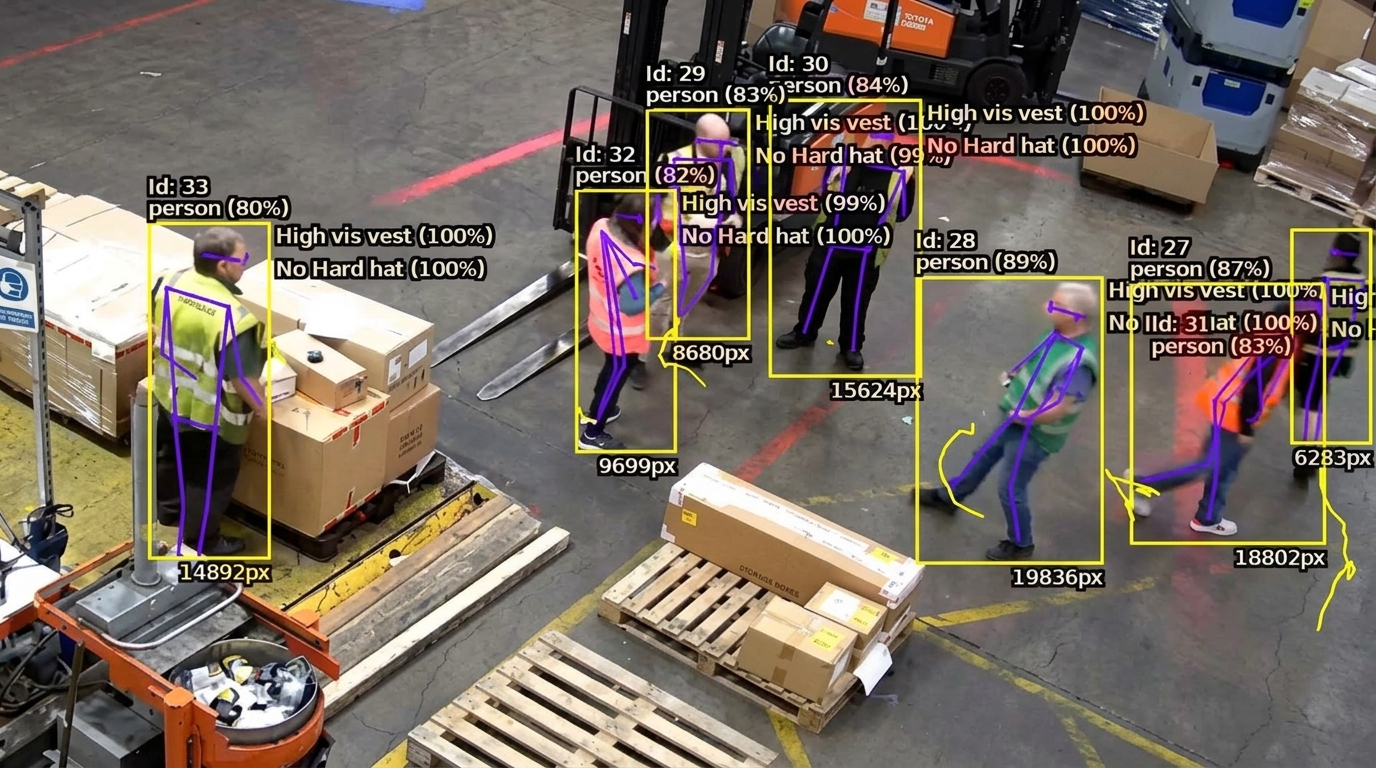
Wavestore's approach keeps detection inside the core platform rather than splitting it across a marketplace or pushing all of it to the edge. WaveView's built-in set includes deep-learning object tracking that classifies people, vehicles and specific objects before an alert fires; behavioural detection covering perimeter breach, loitering, object left or removed, crowd formation and line crossing; deep-learning skeleton tracking for pose detection, fall detection and aggression detection; queue-length and zone-occupancy monitoring; and facial recognition searchable directly within the VMS. A single Wavestore AI Server handles up to 115 deep-learning object-tracking channels (the platform also ships in 8, 12, 25 and 80-channel configurations), and Wavestore states that deep-learning classification reduces false alarms by up to 90% compared with motion-only detection, all without requiring third-party software for core analytics. Both edge-based and server-side processing are supported natively, so a site isn't forced into one architecture the way a purely camera-chip-based or purely marketplace-based platform can be.
Mixed-hardware estates (a camera fleet built up over years from several manufacturers) benefit most from a platform-native or genuinely open architecture, since edge-chip analytics tied to one camera generation won't cover the rest of the estate, and a marketplace-plugin model means checking partner compatibility per camera type rather than once for the whole system.
Single-vendor camera deployments, particularly a fresh Hanwha Wisenet rollout, can get real value from edge-first analytics precisely because the hardware and the detection chip are bought together and tested as one unit, without needing a separate server-side licence for basic detection.
Investigative and forensic-heavy environments, retail loss prevention, transport hubs, large campuses, should weight the platform-native engines (Milestone's BriefCam-powered search, Wavestore's skeleton tracking and facial recognition, both searchable directly inside the VMS) over a marketplace plugin, since forensic search performance and metadata depth are exactly what a vendor-owned engine can guarantee that a third-party plugin can't.
Across all of them, the practical differentiator from the crowd-control and perimeter-protection questions holds here too: whether a detection event lives inside the platform's own event bus and metadata store, searchable alongside everything else, or sits in a separate system that has to be manually correlated during an actual investigation.
"Built-in AI analytics" is a label, not a specification, and the platforms most often named for this question build it three genuinely different ways. Milestone's 2025 acquisition of BriefCam turned what used to be a partner analytic into a vendor-owned one, which is worth checking before repeating older claims about XProtect's built-in capability. Genetec documents its own reliance on named partners like KiwiVision rather than an in-house engine. Avigilon and Hanwha Vision each ship real, named capabilities, Appearance Search and Wisenet's on-camera chipset respectively, without always specifying the underlying architecture in their own materials. Wavestore's WaveView keeps detection, from object classification through skeleton-based pose analysis to facial recognition, inside the core platform, searchable as metadata rather than scattered across a separate marketplace or tool.
What does "built-in" actually mean for VMS AI analytics?
It should mean the detection model is built and maintained by the VMS vendor itself and runs inside the core platform, as distinct from a third-party marketplace plugin or analytics that run entirely on the camera's own chip before the VMS is involved. All three get marketed as "AI analytics," but only a vendor-owned engine gives you a single point of accountability for the model's accuracy and its roadmap.
Does Milestone XProtect have built-in AI analytics?
Yes, as of Milestone's 2025 acquisition of BriefCam. The BriefCam engine is now Milestone-owned rather than a third-party partner integration, and Milestone's own press material states a 38% improvement in real-time throughput for the updated engine, with on-premise processing and no cloud dependencies.
Does Genetec Security Center have its own built-in video analytics?
Genetec's own Resource Center documents its video analytics capability, including KiwiVision Security Video Analytics, as a partner integration rather than a Genetec-built engine, consistent with how Genetec documents its perimeter intrusion detection through named third-party partners.
Does Wavestore require third-party software for AI video analytics?
No. WaveView's object detection, behavioural analytics, skeleton tracking and facial recognition all run natively inside the platform, with both edge and server-side processing supported and no third-party software required for core analytics functionality.

Solutions for a world we can't yet see. Discover v6.52 features helping people and businesses.